 JOPARE MEDIA
 A JOPARE Media channel
The Intelligence Report
Bill Gates’ Africa pledge: health funding, history and the question of trust
Following the $200 billion spending pledge, Dr. Joseph Opare examines the Gates family’s Planned Parenthood connection, the vaccine controversy in India and concerns about population control.
A major pledge—and a question of trust
Bill Gates’ announcement puts an enormous sum of money into the debate about Africa’s health and future. In this episode, published on 5 June 2025, Dr. Joseph Opare asks whether the history behind the donor should shape how African countries respond.
On 2 June 2025, the Gates Foundation announced that most of its planned $200 billion spending over the following two decades would go towards Africa. Health and development were central to the announcement; the entire sum was not an immediate grant to African healthcare.
Opare’s investigation centres on trust. He connects the pledge with the family’s involvement in reproductive-health organisations and the controversy surrounding a Gates-funded vaccine project in India. He asks whether population-control aims could sit behind the promise of assistance.
The family connection and Margaret Sanger’s legacy
In a 2003 interview with PBS, Gates described his father’s leadership involvement in Planned Parenthood. The connection to Margaret Sanger is through that organisation, whose origins are associated with her birth-control campaigning.
Sanger also supported eugenics: the idea that society should shape who reproduces according to judgments about supposedly desirable traits. Planned Parenthood acknowledged and condemned that part of her legacy in 2021.
The episode brings this history into the question of who shapes reproductive-health priorities. For communities receiving outside funding, the important issue is whether their own choices and rights remain central to decisions made in their name.
What happened with the vaccine project in India?
A project run by PATH in India during 2009–2010 used HPV vaccines intended to prevent cervical cancer. PATH confirmed that the project was fully funded by the Gates Foundation.
The controversy produced serious scrutiny. Nature’s reporting on the 2013 parliamentary investigation describes concerns over informed consent, monitoring serious adverse events and the participation of vulnerable and tribal communities. Informed consent means that people understand what is proposed and freely agree to take part.
Those failures matter directly to the trust question. Funding and public-health goals do not remove the obligation to explain a programme clearly, respect participants and investigate concerns. The findings concerned research ethics and oversight; they did not establish a vaccine-based population-control programme.
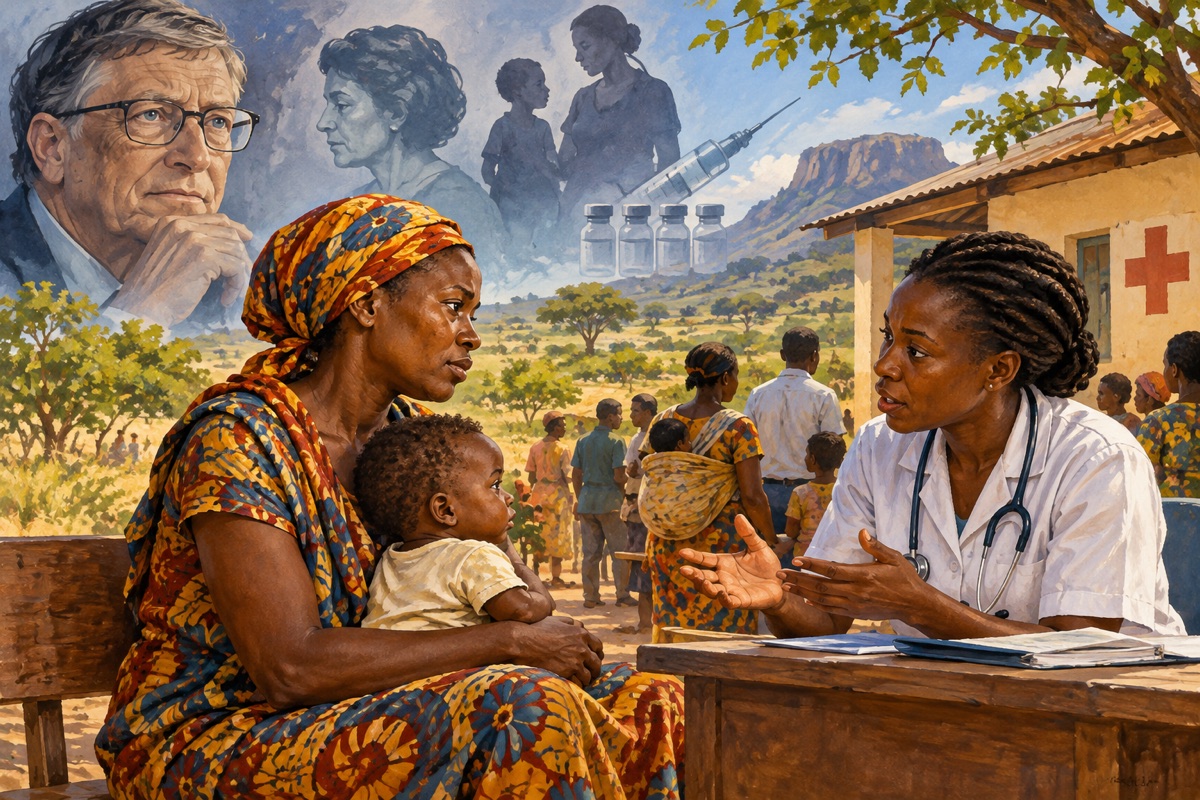
Who decides what happens to African communities?
Opare raises population control as a concern to investigate. That makes the practical questions about power especially important: who chooses the programmes, who sets their targets and who can refuse participation?
African governments and communities need access to the terms of funding, independent oversight and clear routes for complaints. Reproductive choices belong to the people concerned. A large donation should not place those choices beyond public discussion.
The episode asks viewers to consider the pledge alongside the historical connections and the documented controversy in India. Watch Opare’s investigation for his argument about trust, influence and the questions African societies should ask before accepting promises made on their behalf.